Art and (New) Media, Through the Lens of the IMMA Collection
By Maeve Connolly
The term 'New Media Art' is frequently applied to artworks, or art practices,
involving media not traditionally or conventionally associated with the Fine
Arts. Paintings, drawings and sculptures are routinely (although sometimes
erroneously) regarded as original and unique works of art authored by a single
individual, but the emergence of photography, film, video, audio and other technologies
enabling reproduction through mechanical or digital means, radically
alters the relationship between art and originality.1 This is one of the reasons
why artists associated with the historical Avant-Garde, seeking to radicalise
the relationship between art and society, often rejected painting or sculpture
in favour of photography or cinema. Inevitably, however, media that are initially
perceived by the art world as 'new' (such as video in the 1960s) soon become
familiar and even conventional.
Artists have also been drawn towards non-traditional media because they
are specifically interested in exploring the (rapidly changing) relationship between
media, technology and society. These concerns were often evident in the
work of artists associated with the Kinetic Art and Fluxus movements during
the 1960s, such as Nam June Paik, whose installations and sculptures involving
audiovisual technologies explore and contest the power of the mass media.2
More recently, it is possible to trace a continuation of this critical tradition in the
work of a younger generation of artists working with even newer media, from
locative technologies, like GPS systems, to gaming software, bio-technologies
and beyond.
Pictorialism and Performance
While many contemporary art practitioners reject media-based classifications
altogether, categories such as 'Lens-Based Media' can be valuable, emphasising
the parallels and tensions between art practice and a much wider history and
culture of media use and production. Thinking about lens-based practice opens
up points of connection between a contemporary artwork and such diverse
cultural forms as a television news broadcast, a holiday snapshot taken with a
mobile phone, or even a seventeenth-century painting in which the illusion of
perspective was produced with the aid of optical technologies.
Several works in the IMMA Collection that might be classified as 'New
Media Art' allude directly or indirectly to histories of technologically mediated
representation, asserting connections as well as differences between
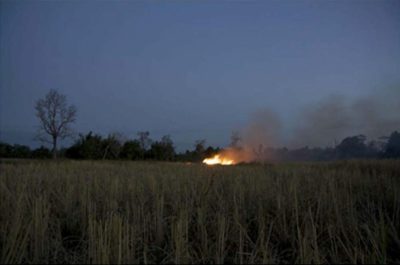
new and older media. So, for example, Caroline McCarthy's two-channel video
work Greetings, 1996, calls to mind a history of landscape representation
that extends from painting to tourist postcards and amateur video, while also
drawing upon a performative tradition in artists' film that is deeply indebted to
silent cinema. The artist composes a picturesque image of the Irish countryside,
complete with drifting clouds and rolling hills, before suddenly jumping up into
the frame to temporarily include herself in this ideal landscape.
Michael Snow's 60-minute single channel video Solar Breath (Northern
Caryatids), 2002, also exploits established traditions of pictorial and dramatic
representation. A highly significant figure for theorists of film in the 1970s,
Snow directs his camera at the billowing curtains of a window opening out
from his workshop onto the landscape of Newfoundland. The window suggests
a frame though which (in narrative cinema) the camera might be expected to
move, or even a proscenium arch within which (in theatre) some action might
take place. Yet, Snow's camera remains resolutely fixed and the viewer is left
only with the fluctuations of the curtain as it moves in the breeze.
Solar Breath (Northern Caryatids) derives much of its appeal from its
status as an unaltered document of a natural phenomenon occurring at a particular
time and place. But for many artists in the 1960s and '70s, the medium
of video was most interesting for its capacity to blur the boundaries between
event and document. Videotape, unlike film, could be played back, viewed
and if necessary re-recorded immediately. Monitors could also be used within
the context of a video work or performance to display a live or delayed image
'feed', enabling various forms of real-time interaction between artist, on-screen
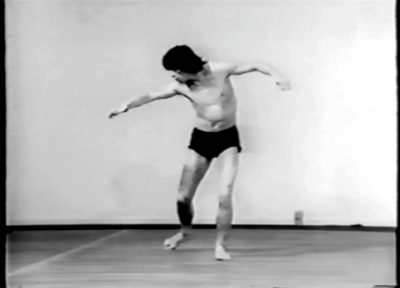
image and audience. In the single channel video Now, 1973, for example, Lynda
Benglis moves between the roles of performer, operator and director, appearing
to kiss a monitor that displays her own image, while continually repeating the
phrases 'Now?', 'Do you wish to direct me?', and 'Start the camera'.
Aura, Materiality and Analogue Technologies
Just as Benglis uses repetition to highlight the specificity of video time, others
have emphasised the distinctive characteristics and properties of photography
and film. Taking the reproducibility of the photographic image as a starting
point, Craigie Horsfield makes only a single print, rather than an edition, and
destroys his original negative. But even though this action results in a unique
artwork, with the same claims to originality as a painting, the title of each work
strongly asserts the specificity of the photographic process. Each title records
where and when the photograph was 'taken' or rather the exposure of the
negative to light as well as a second date referring to the production of
the print.
Clare Langan is also interested in the interplay between painting and
newer media. In films such as Forty Below, 1999, she combines dramatic shooting
locations and hand-painted filters (attached to the lens of a 16mm Bolex
film camera, which is wound by hand) in order to create exotic, otherworldly
images. But although she is clearly drawn to the materiality of film, Langan
seems to favour the expediency of newer image display technologies, because
she exhibits her work on DVD. In contrast, Tacita Dean shoots and exhibits her
moving image work primarily on film, often relying on mechanical looping devices
for continuous projection and sometimes using optical sound so that the
audio is encoded directly onto the celluloid. There is also frequently a relationship
between the themes explored in her work and her attraction to 16mm film,
a medium widely thought to be anachronistic, even obsolete.
There are parallels here with James Coleman's use of 35mm slide projection,
a medium once associated with advertising, corporate communications and
domestic photography. He has produced a number of 'projected image' installations
involving slides, including Background, 1991-94, Lapsus Exposure, 1992-94,
and I N I T I A L S, 1993-94. All three feature highly constructed still images,
synchronised with soundtracks that incorporate voiceover narration. Coleman's
images and scripts are richly evocative and a vast array of historical and contemporary
sources are referenced either directly or indirectly, but he generally
withholds contextualising information, with the result that critics often excavate
earlier works in search of meaning.
Collaboration, Appropriation, and the Politics of Representation
Other artists have embraced technologies and economies of digital media
production and consumption, as well as more collaborative modes of practice.
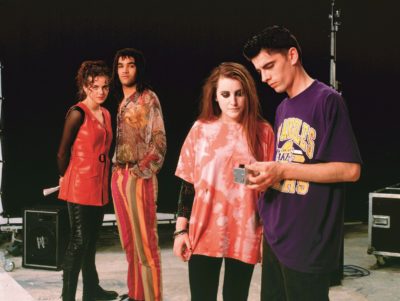
Carlos Amorales' two-channel installation Dark Mirror, 2004-2005, incorporates
animation by Andr้ Pahl and an original score and piano performance by Jos้
Marํa Serralde. Significantly, the animation is derived from a 'liquid archive'
an open and expanding collection of digital images assembled by Amorales'
studio, which is apparently available for use by others. A comparable example
of collaboration can be found in Philippe Parreno's digital video Anywhere Out
of The World, 2000, featuring a character entitled Annlee originated by a commercial
animation company, co-purchased with the artist Pierre Huyghe and
then made available to several other artists in accordance with the principles of
'copyleft'.
This project can be situated in relation to a much earlier tradition of
appropriation, in which artists borrowed and repurposed images from popular
media. Dara Birnbaum was one of a number of artists to work with mass
produced images of women's bodies during the 1970s. Her single-channel video
Technology/Transformation: Wonder Woman, 1978/9, is composed entirely
of edited and looped special effects sequences from the Wonder Woman TV
series, in which 'Diana Prince' is transformed in an explosion of light and sound
into her tightly-costumed, crime-fighting alter-ego.
Willie Doherty's work during the 1980s and '90s is also informed by
critiques of representation. But rather than appropriating material from specific
sources, Doherty explores the recurrence of certain images and narratives
across a range of media, from photo-journalism to film and television drama.
Initially working with photography, Doherty produced a number of black and
white diptychs that combined images of Derry city and its surroundings with
ambiguous yet suggestive text. He gradually moved towards colour photography
and away from the direct use of text on image, relying on titles (as in
the case of Border Incident, 1994) to evoke associations, and developed video
installations, including The Only Good One is a Dead One, 1995, that engage
with locally specific media genres such as television advertisements for the
Confidential Telephone line.3
Gerard Byrne also responds to hybrid media genres, such as the magazine
'advertorial' or the 'roundtable discussion', which may borrow from reportage
or documentary but are nonetheless highly constructed. In Why it's time for
Imperial, again, 1998-2002, Byrne creates a film script from the text of a conversation
between Frank Sinatra and Lee Iacocca (chairman of Chrysler), originally
published as an advertorial for the Chrysler Imperial car in National Geographic.
The text, never designed to be used as a script, is full of awkward phrases and
Byrne exaggerates this quality by staging it three times in different locations.
Byrne's multi-channel installation New Sexual Lifestyles, 2003, is also based
upon a text derived from a US magazine this time a roundtable discussion on
sexuality published in Playboy in 1973. Again the shooting location is highly significant
as Byrne restages the discussion with Irish actors in a modernist building
in Co. Wicklow. Designed as a summer house for the wealthy art patron Basil
Goulding, the building also serves as the subject of a series of photographs
that form part of the work. These photographs are exhibited alongside the
edited footage of the re-enactment, which is presented on multiple monitors
(with headphones attached), a mode of display that suggests the mediatheque
or media archive, rather than the cinema.
Memory in the museum
Even though new media artworks may directly reference or evoke aspects of
popular media production and exhibition, artists generally aim to solicit modes
of engagement that are specific to the spaces and sites of Contemporary Art.4
So, for example, Willie Doherty might structure a video installation (such as
Re-Run, 2002) so that the viewer must continually shift their attention between
two opposing screens in order to 'read' the work. Similarly, seating is rarely
provided for James Coleman's projected image installations; instead, multiple
speakers are arranged around the exhibition space to invite viewing and
listening from different positions. These works demonstrate a sensitivity to the
museum gallery as a space through which the viewer moves, but some artists
have structured their installations around the notion of mobility in even more
pronounced ways.
This is the case with Jaki Irvine's The Silver Bridge, 2003, an eight-screen
video installation that explores the spatialisation of narrative, drawing some
of its themes and images from Carmilla, 1872, a novella by Sheridan Le Fanu.
Widely regarded as a source of inspiration for Bram Stoker's Dracula, Carmilla
is a tale of repressed desire involving two young women. Like much Gothic
literature, The Silver Bridge explores the persistence of attachments to people
and places, and derives much of its power from the use of atmospheric settings
(including the Phoenix Park and the Natural History Museum) as locations. The
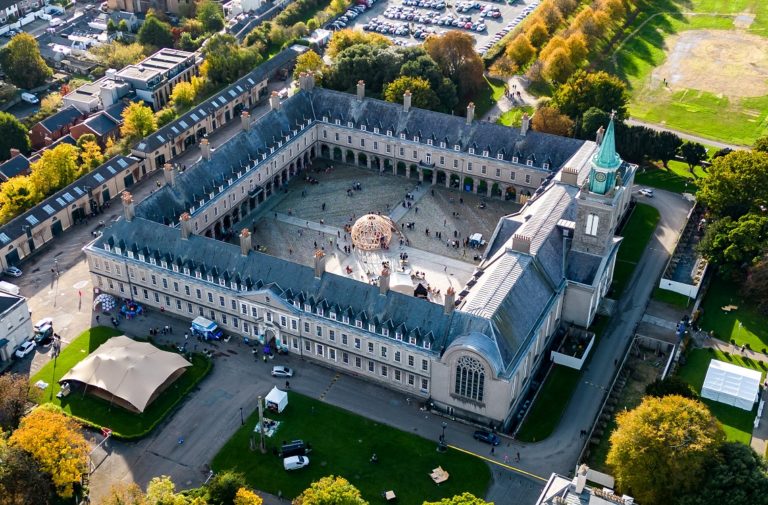
architecture of IMMA provides a particularly appropriate exhibition context
for this work, as the eight projections are dispersed across a series of small
interconnected rooms alongside a corridor, enabling multiple pathways through
the narrative.
James Coleman's Strongbow, 1978/2000, is also concerned with storytelling,
focusing on the fraught interplay between history, myth and media in
Irish culture. One of the first important new media works acquired by IMMA,
Strongbow was placed on public display for several years during the early
1990s. At that time the work consisted of a spot lit replica of a tomb-effigy
found in Christ Church Cathedral, and once assumed to be that of the Norman
knight Strongbow. The replica was displayed alongside a video, on a monitor,
of two hands clapping continuously, with the sounds of the clapping gradually
rising to a boom and then receding. One hand is green, the other red and the
image is distorted so that the hands appear to blur, leaving traces across
the screen.
The work was interpreted in its original form as a critique of television's insistence
on the 'noise and confusion of the present [offering] no particular insight
on the past nor resolution for the future'.5 In 2000, however, Coleman presented
a radically altered version as part of the IMMA exhibition 'Shifting Ground:
Selected Works of Irish Art, 1950-2000'. Strongbow, 1978/2000, was no longer
situated in a darkened space; instead the components were clearly visible and
several new elements had been added. The residue of the plaster mould was
evident on the resin cast of the effigy, and the video of the hands clapping was
displayed on a widescreen 'Sony Art Couture' monitor. In addition, the packing
boxes for several monitors were stacked against the wall, along with a scaffold
tower and the residue of the installation process.
Given its subject matter, these revisions to the form of the work can be
read as a response to the context of the exhibition 'Shifting Ground', which
focused partly on history and identity. But Coleman's action also raises broader
questions about the interpretation of new media artworks. The first version
of Strongbow was produced towards the end of the era of classical 'TV', just
before the widespread availability of home video and the emergence of cable
channels aimed at niche audiences. During the classical era of broadcasting,
television (like radio) had contributed to processes of nation formation
through its insistence upon a continuous, shared, sense of the 'here and now'.
But by 2000, the experience of television and its relationship to the national
context had altered radically. Through the alterations to Strongbow, Coleman
highlights the complexities and the contradictions that are integral to the production
and exhibition of New Media Art, the meaning of which is at least partly
structured by the continually shifting relationship between media, technology
and society.
ฉ Maeve Connolly, 2011
- See Walter Benjamin, 'The Work of Art in the Age of Mechanical
Reproduction' in Illuminations, (ed.) Hannah Arendt, trans. Harry Zohn,
London: Fontana, 1973, pp. 219-254.
- For a recent overview of this tradition see Edward A. Shanken (ed.),
Art and Electronic Media, London: Phaidon, 2009.
- See Martin McLoone, 'The Commitments', Same Old Story, Exhibition
Catalogue, London/Derry/Colchester: Matt's Gallery/Orchard Gallery/
Firstsite, 1997, pp. 8-22.
- For further exploration of this issue see Maeve Connolly, The Place of
Artists' Cinema: Space, Site and Screen, Bristol and Chicago: Intellect
and University of Chicago Press, 2009.
- Anne Rorimer, 'James Coleman 1970 -1985' (1985), in James Coleman
(October Files No. 5), (ed.) George Baker, Cambridge, MA:
MIT Press, 2003, p. 11.
|