Here and Now: Art, Trickery, Installation
By Niamh Ann Kelly
Introduction
Ideas of installation art span a number of art practices and are variously
registered in a range of approaches to the histories and theories of art.
Sometimes permanent in structure, usually ephemeral, installation art prioritises,
as the term suggests, the mode by which art is installed as a crucial
facet in a work's reflexive identity. This emphasis is typically achieved by
ensuring, first and foremost, that the viewer is not a passive spectator but
an active agent in how the work (re)defines place. This open-ended proviso
of installation art acknowledges that reading, in the widest sense such as an
encounter with art, is where knowledge is located. This concept finds a voice
in the words of installation veteran Ilya Kabakov, who has remarked upon
installation as a genre of art that takes note of a "shift from object knowledge
to subject experience".1 The functioning of installation art thus depends upon
the presence of the viewer daily transformed, willingly or unsuspectingly, into
necessary participants in the life of an artwork at a particular location.
From this premise and in the light of contemporary alertness to cultural
relativities through constantly changing notions of community, to compile
a definitive history of installation art is a possibly impossible project. Claire
Bishop acknowledges the cultural limits of her study on Western installation
art, while Erika Suderburg comments that installation art is a solely Western
art-historical construct.2 The disparity of these disclaimers serves a clear
reminder that writing on art is always about points of view. Similarly, to claim
an authoritative set of characteristics as central to all installation art would
be a clumsily conventional and unproductive task. Instead I will focus on
what can be identified as repeated themes and motives behind some exigent,
influential and inspiring samples of installation art, in the hope that drawing
attention to these topical aspects might contribute to general understanding
and engagement with the persuasive power of this genre to make art experiential
and immersive.
Locating the Viewer
A recess in an interior wall of a room appears to have a full vase of flowers,
and a nearby window seems surrounded by a billowing curtain. On closer
inspection, the sense of depth, texture, light and even life, is revealed as
an illusion: a flat wall meticulously painted to provide the eye with the impression
of features not actually there. Trompe l'oeil is a manipulative mode of
image making and produces a vision, which can only be realised by the artist
through a considered awareness of the viewer: understanding how they see
and where they stand.3 The resulting theatrical potential of painting can function
as a metaphor for the wider trickery of art: to manipulate and undermine
easy distinctions between experiences of life and of art, and between perceptions
of reality and of representation.
Trompe l'oeil is evident in imaging practices from as early as classical
painting and is arguably present in any attempts at depicting perspective, but
is most readily identified with the Baroque period. As in trompe l'oeil, two of
the core tasks typically undertaken by installation art revolve around how space
is experienced and the activity of the viewer in a changeable contract between
illusion and presence. This dual interest is echoed in the work of Jorge Pardo.
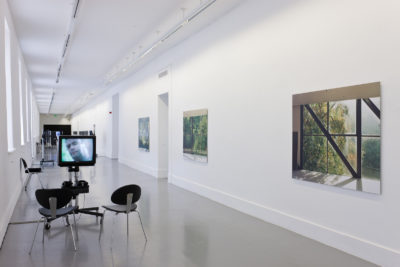
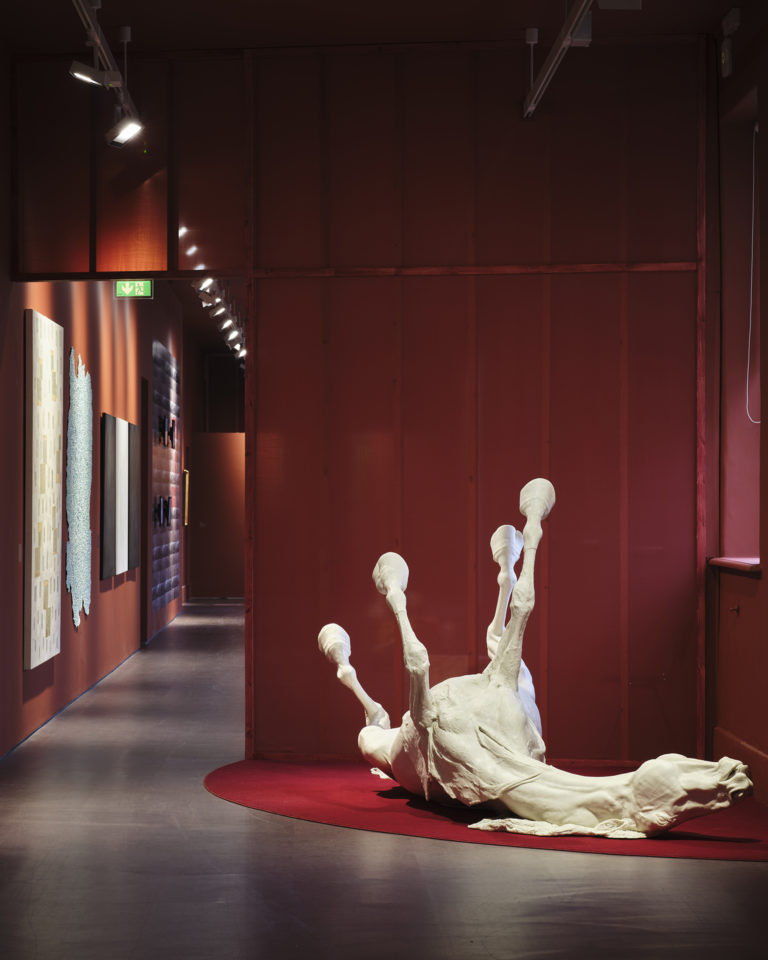
In his exhibition at the Irish Museum of Modern Art, 2010, and in particular by
his rendition through photo-wallpaper of interiors belonging to rooms elsewhere,
Pardo plays on the viewer's sense of here and now, by insistently presenting
an illusionary representation of elsewhere, at another time. A sequence
of superimposed images along the museum's exhibition corridor re-envisioned
the space as a reference to his there-and-then, inviting the viewer into his personal
history as an artist. In 4166 Sea View Lane, 1998, Pardo fully decommissioned
the gap between everyday life and art: a house in Los Angeles was built
as both an artwork and his place of residence.4
Arising from the observation that installation art prioritises viewer
engagement, a useful point of differentiation between taking account of art
as object and art as installation might be considered as part of a growing and
determined insistence of artistic control over commissioning and curatorial
power. Installation works by Ann Hamilton have progressively pioneered immersive
experiences in which the duration of viewer engagement is vital. Often
site and context-specific in her work, she also produces installations that are
equally object-driven, such as Filament II, 1996. In this work, an organza curtain
on a circular rail is mechanically programmed to spin, and to experience it the
viewer must enter it. In theory, such an artwork can be described as a filledspace
type of installation, as opposed to a location-specific work, to borrow
Mark Rosenthal's explanation: it be packaged and remade elsewhere, if a little
differently.5 Nonetheless, as with all her work the role of the viewer is an active
one, necessary for the work to make sense.
Joan Simon points out that there is a "dynamic relation between the experiential
and the picturesque" in Hamilton's installations.6 Hamilton exerts a
concerted control over the presentation of Filament II, for example, by maintaining
the centrality of the viewer's spatial immersion in the work, where a
purely object-based piece might be (re)positioned more arbitrarily. In this
reckoning, in installation art practices the artist's awareness of the extent to
which a viewer activates the work supersedes the managerial influences of
the commissioner and/or curator. This power struggle has taken the form of
an art that, in an out-right manner, proliferates space beyond the conventional
art object, and therefore directly implicates the viewer and importantly,
their experience, immersive or otherwise, as part of the work. Vanessa Hirsch
identified in her discussion on Marcel Duchamp's Exposition Internationale
du Surréalisme, Paris, 1938, that the work: "bursts the spatial restrictions of
a work of art".7 This bursting forth, in all directions, is a symbolic tearing
down of previously proffered boundaries of art - media specificity, discipline
alignment, site of production, place of presentation and social function.
Pushing the Boundaries of Art
Installation art is repeatedly distinguished as a genre of the late-twentieth
century by a notable upsurge in artists' stated interests in the potential for
social change fostered by an emphasis on the experiential outcome of art,
as epitomised in the rhetoric of Joseph Beuys among others.8 As a distinctive
method of making art, installation art at this time challenged the reduction of
art to an economic chip, tool of cultural discrimination or mechanism for social
exclusion. Debates around art's relationship to reality, in particular everyday
socio-economic reality, lie at the heart of the preliminary indications of installation
art as distinctive intentional genre, apparent in diverse collective and
individual works.9 In 1961 a clearly intended installation-style work presented
a smart critique of the values associated with material culture broadly. Claes
Oldenburg's The Store was a collection of typical saleable objects rendered in
papier-mâché, such as a dress and decorative ornaments. Displayed in a rented
store-front in the lower East Side of New York City, the artwork was a conflation
of artefacts represented in a manner that denied their function within a viable
commercial site. Oldenburg thus simultaneously queried the purpose of shopping
and of art in a witty swipe at where and how cultural value is played out
through social mores of consumption.
The Store also marked the displacement of studio that occurs in installation
practice as the work is definitively constructed at the location of its
presentation, in Julie Reiss' words "the site is the studio".10 Taking a sincere if
belated cue from Oldenburg, forty years later, Michael Landy took all his material
possessions and placed them on a specially constructed conveyor belt in a
disused department store in London. In the space he bagged and tagged the
items and created an inventory with various categories, before everything was
destroyed. Break Down lasted for two weeks, by which time all his material
belongings were destroyed. A self-conscious search for identity through a thoroughly
destructive act, Break Down also constituted a determined disregard for
the rift between studio and display, and negated the separation of performance
from installation.
Rosenthal has described installation as an "elastic medium that compromised,
even democratised, the sphere of art": presumably Landy's choice of
venue and actions were indicative of an agenda to democratise art by enacting
a refutation of personal identity on the high street.11 Landy's work, however,
demanded witnesses and in this, as Reiss has suggested in general, the
prominence given to the viewer's experience makes installation art resistant to
conventional methods of historicisation. The subversion of the spaces and practices
of everyday life presented in the installation work of Oldenburg and Landy
institute a defiant attitude towards necessarily chronicling either art or society
in the terms received by their respective generations.
Disregarding the limitations of defining artworks in terms of objects, media
or discipline is conspicuous in the light and environment works of artists such
as James Turrell, Robert Irwin and Olafur Eliasson. The systematic laboratory
style explorations of visual and psychological perception by Turrell and Irwin
highlight another shift in studio practice towards an experimental model in
which intermittent presentations of installations in the form of exhibitions
are simply expression, or even research, points in ongoing processes of art
making. Eliasson's works distill or reconstitute natural phenomena into galleries,
institutional environments and constructed exhibition sites to ultimately
confront the capricious divide between outdoors and indoors, and so question
the lived relationship between natural orders and contemporary culture.
Friedrich Meschede claims that the outcomes of Eliasson's practice "render
visible our fascination with the elements".12
Springing from a sustained and ongoing dialogical practice, Eliasson's
art installations vary from subtle interventions to truly spectacular
manipulations of environments. The Weather Project at Tate Modern, 2003,
exemplifies the latter: the creation of an artificial sun, complete with ambient
golden haze in the Turbine Hall. In other of Eliasson's work, olfactory
and aural senses as well as visual and spatial perceptions are called upon in
fuller explorations of the synaesthetic potential of art. As constructions of
spaces that intervene at various sites to refocus personal and shared senses
of location, installation art, through committed boundary-breaking, highlights
how temporal experiences call attention to the precariousness of systems of
representation.
Performativity and the Theatre of Representation
Michael Fried's now famous essay on 'Art and Objecthood', 1967, pinned a
demarcation between autonomous art, which Fried argued could trigger
absorption, and objects in context, that became, in his terms, art in the
presence of the viewer through a reliance on theatricality.13 Intended as a
criticism of minimalist sculpture, the debate that Fried's text has come to
represent has polarised theorisations on art practices of the late modern
period. Nonetheless, the revolution of how notions and devices of theatrical
staging have become, widely, integrated into subsequent art practices, and
especially into installation (and obviously performance) art, remains of great
significance in how artists have challenged the field of representation, more
generally. Angelika Nollert has commented: "Art, like theatre, opens up spaces
where illustrations can become happenings - ones which thrive on the
awareness of their simulation".14
Kabakov, who works in collaboration with his wife Emilia, has even
developed a subgenre of installation art in his theatre installation works.
Throughout his practice, Kabakov eschews the possibility of complacency
on the relationship between individuals and their environment, by focusing
on the interaction between social conditioning and realms of imagination.
The Children's Hospital, 1998, made for the Irish Museum of Modern Art,
draws on the history of the museum site as a hospital and is combined with
an interest in using fantastical elements to promote health - such as small
mechanical theatres to provide entertainment for hospitalised children.15 The
life-size scale of the hospital rooms clearly positions the viewer as the subject
of the work and reorients the viewer's consciousness of the unnervingly
trans-cultural codes of institutional spaces.
The staging of collective culture is also a driving concern in some works
by Fred Wilson and Mark Dion. Their works, respectively, query the legitimacy
of methods of cultural and historical representation and the basis of our
enthrallment to codes of display in determining, as Flora Kaplan succinctly
phrased it, "the making of ourselves".16 In the spaces of installation art, Wilson
and Dion have systematically subverted systems that most readily make and
perpetuate notions of otherness as the blinding base on which the formation of
selves occurs, time and time again. Wilson eloquently noted the importance of
location for his work at the 50th Venice Biennale in 2003, Speak to me as I am,
which included a range of materials to illuminate and interrogate the framed
position of Africans in Venetian art history. Wilson also commissioned a
Senegalese vendor to sell handbags at the entrance to the main exhibition area
in a deft gesture depicting multicultural Venice. The bags were designed by
Wilson but were mistaken by the local police for illegal designer knock-offs.
Dion in his alternative archeology in Tate Thames Dig, 1999, for example,
reinvents systems of value enlisting professional help across disciplines to
present incidental throwaway culture as notice-worthy artefactual finds.17
For artists such as the Kabakovs, Wilson and Dion, a viewer's activated
present-ness, being there, is key to the raison d'être of their works, which
implies that installation art is in no small part a matter of spectacle, albeit a
spectacle fashioned by blurred delineations between concepts of document
and simulation. Comparisons are often evoked between installation art
and cinema and theatre, but the comparisons are limited. In a cinema, as
de Oliveira points out, the screen divides audiences from the form (though
perhaps less so with three-dimensional effects).18 Also, in a theatre, audiences
are usually a silent, seated and still mass, separated from the stage and
actors. Installation art activates the spectacle, thus extending the theatrical
stage of culture into subjective experiences. The viewer is on location and an
essential element of the scene in an engagement that confounds expectations
of art as a purely representative practice. De Oliveira phrased it: the
artist and viewer are together in a discursive environment.19 In other words,
the experiential outcome of physically being in the work fosters a sense of
dislocation from both everyday life and art, disavowing segregated concepts
of reality and systems of representation.
Some historians, like Reiss, contend that installation art began as an
alternative practice of cultural discourse that has migrated from its origins
on the margins of mainstream culture to the very centre of institutional
practice.20 It can equally be interpreted that, far from sitting pretty in the
seat of cultural power, installation art in museums or as part of large-scale
commissioned projects can function to effectively perplex politics of representation
at play in such traditional set-ups. Jacques Rancière's hypothesis of
artistic practices as 'ways of doing and making' that intervene in the general
distribution of ways of doing and making as well as in the relationships they
maintain to modes of being and forms of visibility", seems to iterate the
transformative potential of art on concepts of public domain and dominion.21
Installation art, then, as method of space reclamation, can re-territorialise
culture from either margins or centres of commissioning authority, by virtue
of an insistence on the viewer as indispensable to the work.
The practice of the Situationist International from 1957, set the scene
for a discussion on psycho-geography and highlighted the importance of
considering the urban public sphere as a living, changeable, subjective,
as well as shared, space.22 Many public art projects - both temporary and
monumental installation works - extend these concerns, where the site of art
becomes a cue to reconsider the past in the present day. Installation art is
viewed, but it is also heard, smelled and touched, enlisting the viewer in an
active engagement that reflects the lack of closure, even interpretative
restlessness, proposed by the Situationists. Bishop writes that art installation
is a co-joined experience of activating viewers and decentering them as
subjects. In a visual sense, she evokes this decentering in terms of a history
of pictorial perspective, but one that is insinuated into the identity politics
of fragmentation within postmodern theory: "[...] installation art's multiple
perspectives are seen to subvert the Renaissance perspective model because
they deny the viewer any one ideal place from which to survey the work".23
Through his work in urban spaces, Thomas Hirschhorn has elaborated
on a desire to generate art as a place for social interaction, where communication
is open-ended. At Documenta 11, 2002, in Kassel, Germany, Hirschhorn
developed a layered project that included a makeshift port-a-cabin library and cafe thematically
dedicated to the philosopher Georges Bataille.24 Situated
in a suburban area away from the main exhibition venues, and primarily focused
on engaging the local community, Hirschhorn's work pointedly prioritises the
role of viewer-participant as the purpose of the materiality of the work: a library
or cafe is only communally recognised as such if it is utilised. Nollert's description
of 'performative installation' as a social space applies here: the performativity
of the participants is reliant on the presence of the work, but is not
entirely controlled by it.25 The performativity aspect that attends installation
art implies a counterpoint to predetermined representative processes, and
renders the practice of installation art one of constant transition and art
installations guaranteed uncertain outcomes.
Towards a Conclusion
When Marcel Duchamp attempted to place his 'readymades' in a gallery
in 1917, he in effect stated that critiques of institutions of representation are
a necessary part of art.26 A urinal was deemed a fountain in the eventual
transition from plumbing outlet to gallery plinth and so questions were raised:
What is everyday life? What is art? Who decides these questions?27 The advent
of installation art harnessed these questions into: What is real? What is
representation? As a result, many terms have been applied to installation art
- category, event, environment, intervention, site, space, medium, assemblage,
ensemble, simulation, construction. This indicates that comprehending the
guises of art forms is much more complex than a historical litany of media
practices can explicate. The distinctions of art genres is critically linked to shifts
in social, economic, geographical and virtual contexts of how and where art
is read, experienced and historicised through collections, exhibitions and
documentation.
In an age defined by paradigms of mobility when potential to journey
seems evermore widely available, artists are increasingly nomadic and virtual
travel re-characterises the geography of social networks, the desire for physical
spaces where contemplative, confrontational and participatory spectatorship
can occur is peculiarly constant. Recognising, temporarily, installation art as a
genre – with its inherent demand upon the viewer to get involved, here and now
– crystallises the continued importance of the sublime contradiction of art as a
persistent form, and site, of expression and communication. Potentially an
interruption of everyday life, art can also be integral to daily living: manifesting
in installation art as an active mode of cultural challenge and ideological
confirmation.
© Niamh Ann Kelly, 2011
- Quoted in Nicolas de Oliveira, Nicola Oxley and Michael Petry, Installation Art in the
New Millennium: The Empire of the Senses, London: Thames and Hudson, 2003, pp.
14-15.
- Claire Bishop, Installation Art: A Critical History, London: Tate Publishing, 2005,
p. 13; Erika Suderburg (ed.), Space, Site, Intervention: Situating Installation Art,
Minneapolis/London: University of Minnesota Press, 2000, p. 10.
- The term trompe l'oeil is literally French for trick the eye. For discussions on the
significance of trompe l'oeil see Hanneke Grootenboer, The Rhetoric of Perspective:
Realism, Illusions in Seventeenth-Century Dutch Still-Life Painting, London/Chicago:
University of Chicago Press, 2005 and: Parveen Adams 'Out of the Blue', in Carolyn
Bailey Gill (ed.), Time and the Image, Manchester: Manchester University Press,
2000, pp. 61-68.
- Built with a financial contribution from the Museum of Contemporary Art, Los
Angeles, the house was primarily financed by the artist. The 3,200 square-foot
house was on exhibition to the public for five weeks in 1998, and is now the artist's
main residence and indicative of his work where separations between art, design
and architecture are intentionally negligible.
- Mark Rosenthal, Understanding Installation Art: From Duchamp to Holzer, Munich/
Berlin/London/New York: Prestel Verlag, 2003, p. 28. De Oliveira draws attention to
the debate on 'interior art' taken up by Camiel van Winkel, which also suggested
an inherently self-contained type of material element, op. cit., p. 29.
- Joan Simon, Ann Hamilton, New York: Harry N. Abrams, 2002, p. 17.
- Vanessa Hirsch, 'From the Sound of Colour to the Dissolution of Disciplines: Synaesthesia
in Twentieth-Century Art', in Olafur Eliasson: Scent Tunnel, A Project for the
Autostadt in Wolfsburg (Catalogue), Ostfildern-Ruit: Hatje Cantz Verlag, 2005, p. 99.
- Joseph Beuys repeatedly espoused the idea that art could transform daily life,
that everyone can be/is an artist. See Mark Rosenthal, Sean Rainbird and Claudia
Schmuckli (eds.), Joseph Beuys: Actions, Vitrines, Environments, London: Ménil
Collection in association with Tate Publishing, 2004.
- Clearly many artistic practices have paved the way for installation art: among them
the practices of the Dadaists and Surrealists as well as the interrelated aspects of
Allan Kaprow's notion of environments, Jim Dine's use of assemblages, the performances
of the Viennese Actionists and ideas incorporated in the staging of happenings
and events from the late 1950s. Earlier works such as Proun Room, 1923,
by El Lissitzky and; Merzbau, 1926-1936/37 by Kurt Schwitters have a significant
formative influence on what we call installation art today.
- Julie H. Reiss, From Margin to Centre: The Spaces of Installation Art, Cambridge
(Mass.)/London: MIT Press, 1999, p. xvii. The placement of the studio of Francis
Bacon as an exhibition in Dublin City Gallery The Hugh Lane articulates a popular
resistance to the demystification of the art process sought by installation
practices. In a related vein, the fascination with photographs, films, and even
partial re-creations of Piet Mondrian's studio fashions this interest with artists'
studios as a site of spectacle.
- Rosenthal, op. cit., p. 25.
- Friedrich Meschede, 'For All the Senses', in Olafur Eliasson: Scent Tunnel, A Project
for the Autostadt in Wolfsburg (Catalogue), Ostfildern-Ruit: Hatje Cantz Verlag,
2005, p. 82.
- Michael Fried, 'Art and Objecthood', first published in Artforum 5, June 1967. See
Michael Fried, Art and Objecthood: Essays and Reviews, London/Chicago: University
of Chicago Press, 1998, pp. 148-172.
- Angelika Nollert, Performative Installation (Catalogue), Snoeck/Siemens Art Program,
2004, p. 22.
- Discussed by Johanne Mullan in Irish Museum of Modern Art: The Collection, Dublin:
Irish Museum of Modern Art, 2005, p. 96.
- See Flora Kaplan (ed.), Museums and the Making of "Ourselves": the Role of Objects
in National Identity, London/New York: Leicester University Press, 1996.
- See Fred Wilson, Speak Of Me As I Am, Cambridge, MA/London: MIT List Visual
Arts Centre, 2003 and; Mark Dion, Archaeology, London: Black Dog, 1999.
- De Oliveira, op. cit., p. 23.
- Ibid., p. 14.
- Reiss, op. cit.
- Jacques Rancière, The Politics of Aesthetics, London: Continuum, 2002, p. 13.
- See Guy Debord, Correspondence: The Foundation of the Situationist International
(June 1957 - August 1960), Los Angeles: Semiotext(e), 2008.
- Bishop, op. cit., pp. 11, 13. Many installation works can be understood in this light.
The anti-monument works of Jochen Gerz are indicative of these concerns where
the monument is either invisible or becoming less visible. In the mirror works of
Dan Graham the frustrations of perspective are realised by the possibility of multiple
viewpoints as the works interact with their environment to render obscure clarity
between reality and reflection. Collaborative artists Denis Connolly and Anne Cleary
have created works based on scenarios of appearance and disappearance of the
engaged subject through live and delayed projections.
- One aspect was a pamphlet available on site, which included: Christophe Fiat,
'Thomas Hirschhorn: The Experience of Violence in Sacrifice', Documenta 11_Platform5:
Exhibition (Catalogue), Ostfildern-Ruit: Hatje Cantz Publishers, 2002, pp. 564-567,
a text commissioned by Hirschhorn, addressing Bataille's work.
- Nollert, op. cit., pp. 13, 20.
- Assuming the pseudonym and later ego of a Richard Mutt, French artist Marcel
Duchamp submitted the work for exhibition with Society of Independent Artists
New York in 1917. When the work was hidden from display, the controversy was
sustained in The Blind Man journal, Vol. 2 that year.
- Belgian artist Marcel Broodthaers brilliantly queried the casual persuasion of
iconographies of power in the form of insignia, emblems, symbols and cultural
display practices to demonstrate the terrifyingly thin line between what a society
may understand as reality through representational practices in his so-called
'museum fictions' works in the 1960s and '70s. Discussed by Steven Jacobs, in
S.M.A.K. Museum of Contemporary Art/Ghent, Ghent and Amsterdam: Luidon,
1999, pp. 96-103.
|