Image of Reality / Image not Reality: What is Photography?
By Fiona Loughnane
What is Photography?
From its beginnings, photography has been marked by its versatility. The
camera has been employed for personal use in family snapshots; official use
to create visual records (examples include passports, medical records and
mugshots); commercial use in advertising images; and creative use in art
photography, to list just a few examples. Photography has also engaged in
constant technological innovations, leading to enormous differences in the
physical character of the image; from daguerreotypes to images printed from
a negative, from plate glass to film and from analogue to digital. Given this
diversity, the photograph has always been difficult to define and contain.
The apparently basic question 'What is Photography?' provokes complex
responses that need to consider the diverse roles and characteristics of
the photograph.
In 1922, in a letter to the photographer Alfred Stieglitz, Marcel Duchamp
declared: 'You know exactly how I feel about photography. I would like to see
it make people despise painting until something else will make photography
unbearable.'1 Today the camera seems more firmly embedded in visual culture
than ever; every mundane event or passing sight instantly captured and
shared in an age of 'smartphones' and social networking sites. The ubiquity
of the photographic image has perhaps created an oppressive presence in
everyday life. The colonisation of every aspect of life by photography is not a
recent development; however the invention of photography in the late 1830s
quickly led to a dramatic increase in the production and circulation of images.2
Photography has been seen as a documentary tool, allowing for realistic
depictions of the world, and as a creative practice, now a central medium
within the fine arts. The interchange between these opposing views of the
medium – factual and imaginative, everyday life and 'high' culture – has
created a rich field of image production.
Photography and Modernity
Roland Barthes pointed out that photography in its earliest years depicted
remarkable things, but over time things became remarkable simply because
they were photographed.3 The development of a medium that allowed for
a quick and accurate reproduction of the world meant the creation, for the
first time in history, of a visual record of all aspects of life. Photographs offer
a visual knowledge of the world outside direct experience. This knowledge
is abstracted and second-hand, but it nonetheless creates a strong sense of
recognition.4 Visual representations became increasingly important in the
dissemination of knowledge; the endless reproducibility of the photograph
made it a central feature of modern, spectacular, consumer society.
Photography did not simply represent modern life, it became one of
the conditions associated with modernity. Advancements in technology,
especially those related to transport and communications, gave a sense of
life lived at greater speed accross shorter distances. Photography allows
for quick, accurate recording of things and its placing of distant objects,
places and people, directly in front of the viewer, had the apparent effect of
abolishing both time and distance.
Photography inserted itself into discourses, such as tourism,
criminology and medicine, often becoming a tool through which institutional
power was exercised.5 The photographing of people and places did not
always make the distant and strange seem familiar; photography, especially
in its institutional use, frequently asserted difference.
John Lamprey, active in the 1870s, sought a standardised means to
depict the human body for his anthropological research. He photographed
the nude figure, in full-length front and side profiles, against a gridded
backdrop. His methods gave the illusion of a neutral, disinterested, scientific
discourse, allowing him to compare differences between races. However,
Lamprey's work didn't just record difference, it also constructed it. His project
was 'steeped in colonial ideology and illicit desire' and served as a visual
representation of western power over the 'other'.6
Image of Reality
Early accounts of photography often displayed a clear sense of wonder
at a process that showed a miraculous ability to record the world.
Walter Benjamin cited the response of German author, Max Dauthendey,
to early portraiture:
We were abashed by the distinctness of these human images, and
believed that the tiny faces in the picture could see us, so powerfully
was everyone affected by the unaccustomed truth to nature of the first
daguerreotypes.7
Despite such accounts, the photograph's distance from reality can
be seen from its distortions of time and space; its two-dimensionality; its
selection and omission of objects through the framing of the camera's lens;
the frequent absence of colour; and its stillness. However, despite these features,
photography has been seen to have a necessary link with reality.
This connection to reality is often cited as the reason certain photographs
generate a charged or emotional response from viewers.
The photograph has been described as indexical, a sign carrying
a trace of the real, because of the way analogue photography records a
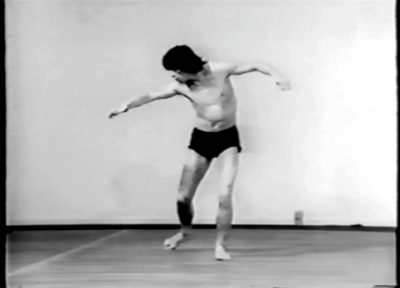
physical trace of the light as it falls on actual objects. Dennis Oppenheim's
work from 1970, Reading Position for Second Degree Burn, is an illustration
of photography's indexical properties; a photograph of the artist as a
photograph. In the work, Oppenheim turned his torso into a light-sensitive
plate, sunbathing with a book on his chest, and recording the result in a pair
of 'before and after' photographs. It's a compelling demonstration of the way
traditional photographic methods both depict the objects that appear before
the camera, and contain physical residues of them.
Photography was also considered to offer a truthful depiction of
the world because it avoided the personal, subjective expression of media
such as painting. In contrast, the camera was seen to offer an objective
means of recording subjects that documented rather than interpreted.
Photographic documents aspired to a 'straight' photographic style – direct
and unmediated – that described 'facts' in a neutral, scientific way.
John Lamprey's work demonstrates that claims to scientific objectivity
were often spurious. Our experience of images is never entirely free of
interpretation, and the meanings we ascribe to photographs are strongly
influenced by the context in which we encounter them. Photographs are
rarely presented in isolation; even personal snapshots are often experienced
in the context of the 'family album'. The supposed truth and objectivity
of photography is as much a symptom of institutional authority, as a
characteristic of its physical properties.
One way in which the meaning of the photograph is fixed and made
clear is through the use of the caption. Walter Benjamin described the
caption as an imperative directive to photographic meaning that created
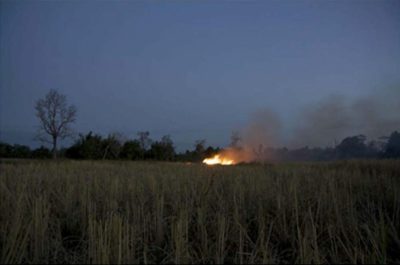
signposts for the viewer.8 Another paired set of images, Incident, 1993 and
Border Incident, 1994, by the Irish artist Willie Doherty, demonstrates the
way our understanding of photographs is informed by the context in which
they are viewed and how language supplements the image in the form of
title and/or caption. Both images are large, detailed, close-ups of burntout
cars abandoned in the landscape. The straight on camera angle in the
photographs adds to the sense that we are being presented with a factual
description. Both works are given a political charge because of the use of the
words 'border' and 'incident' in the titles, immediately evoking the violence
of Northern Ireland's recent past and suggesting that we are looking at the
aftermath of conflict. However, one of the two images depicts a car that has
simply been illegally dumped. Typically for Doherty's work the signposts
offered by the titles misdirect rather than guide.
When digital processes first became widespread in the 1990s, they
were seen by many to mark the end of any claims to photographic 'truth'.
Rather than carry a physical memory of light falling on objects, digital images are reconstructions
using binary code, and can therefore be seen as further
removed from reality. As we have seen, viewing photographs as a slice of the
'real' has always been problematic, no matter what form they take.
The field of photojournalism is most vulnerable to doubts about
photography's relationship to reality. For many the most important role
of the camera has been its ability to 'bear witness' to the major events
of history. Photojournalism certainly seems less prestigious today than in
its heyday from the 1930s to the 1960s, when magazines such as Life and
Vu were dedicated to the narration of current events through the picture
story. However, the decline in photojournalism has less to do with doubts
about photographic truth, than with the emergence of new media and
forums for the circulation of news images. Many of the images of the recent
'Arab Spring' revolts were taken by protestors and ordinary citizens, who
then circulated the images on the Internet. Such developments offer the
possibility of more democratic documentary practices. In the past the
figure of the photojournalist or documentary photographer suggested a
heroic figure (by virtue of both skill and bravery) who occupied a superior
position relative to his/her subjects, often presented as passive victims of
events.9 Digital technologies seem to offer the possibility that such victims of
circumstance can achieve agency through recording their own trauma.
Outside these debates, in our everyday experience of visual culture,
we continue to invest in the belief that photography presents a reliable and
truthful account of the world. We expect images of products displayed by
online stores to relate to the items for sale, and tend to believe in the image
more than the textual description. The item for sale on e-bay, without an
accompanying photograph, is assumed to be in dreadful condition, no matter
how enthusiastically its virtues are listed by the seller.
Image not Reality
While some have prized photography for its ability to document and
record the world, others have been drawn to the creative possibilities offered
by the camera. Photography was initially positioned as a creative practice
through emulating existing fine art media. The earliest photographs depicted
genres established in painting: the still-life, the nude and the landscape.
From the 1850s a style of photography known as 'pictorialism' emerged. The
pictorialists recreated the type of sentimental, narrative subject found in
nineteenth-century art, often producing very elaborate, multi-figural scenes
through using techniques like combination printing. Pictorialist imagery
tended to employ soft focus and made the surface of the photograph appear
expressive and individual, by scratching into or drawing on negatives.
In the early twentieth century, with the emergence of avant-garde
groups such as Dada, Soviet-Constructivism and Surrealism, there was a
radical change in approaches to photography as art. These groups were
drawn to photography's modernity and, rather than relating it to painting,
they sought a new aesthetic based on the operations of the camera. Avantgarde
photography tended to employ a sharp focus and often depicted
modern subjects, such as Albert Renger-Patzsch's images of industrially produced
commodities or László Moholy-Nagy's images of the Eiffel Tower.
Aleksandr Rodchenko felt that photography allowed artists to move
away from the 'old point of view' which he associated with bourgeois 'belly
button shots' and argued that the camera enabled less conventional views of
the world, such as views from above and below (bird's eye and worm's eye
viewpoints), extreme close-ups and cropping.10 Photography was also seen
as an exciting extension to natural vision, recording sights unavailable to the
human eye. Microphotography using powerful magnifying lenses, the use of
series of cameras to capture motion and X-rays, all extended natural vision,
creating what Walter Benjamin referred to as 'the optical unconcious'.11 While
avant-garde photographers were interested in photography's connection to
reality, they were also concerned to dismantle and subvert the reality of the
photograph. Techniques such as photomontage, photograms, doubling and
solarisation emphasised the photograph's status as a made image and its
distance from the real.
Some art photographers, particularly those associated with Aperture
magazine in the 1940s and 1950s, produced a type of modernist pictorialism;
moody black and white images that abstracted their subjects and emphasised
the expressive qualities of the camera. David Campany has argued that this
approach was concerned to separate photography from everyday, vernacular
snapshots. This is why they chose to use black and white rather than colour;
produced images that were expressive rather than descriptive; and often used
unusual angles or framing to create abstract effects.12
In contrast, other art photographers engaged in a 'documentary
style', often focusing on urban life in street photography.13 John Szarkowski's
influential catalogue, The Photographer's Eye, was centred around these
practices by artists who were united by an interest in the vernacular snapshot,
using its tropes to give their artfully composed images a careless, everyday
quality. As with earlier avant-garde ideas, this approach to photography
attempted a codification of the medium, based on qualities inherent to the
camera. Szarkowski argued that one of the central features of the camera is the
way it causes us to see the world as an image (the thing itself), framed, isolated
and ultimately separated from the world by the act of photographing (the
frame). The resulting image is separated from the flow of time, and causes an
attentive form of viewing, often focusing on compelling details.14
Artists from the 1960s began to move away from seeing the photograph
as art, and were instead drawn to its everyday documentation of the mundane.
In this they were strongly influenced by conceptual art, in particular its
mistrust of the expressive aesthetic of modernist art, engaging instead in an
art of intellectual enquiry. Conceptual artists employed photographs as blank,
neutral documents, but soon this became an influential aesthetic within art
photography, most famously represented by the exhibition, New Topographics:
Photographs of a Man-Altered Landscape, held in the Eastman House Museum
of Photography, New York in 1975.15
This approach to the image continues to be influential in contemporary
art, however, apparently neutral documentation of the everyday spaces of life
can often be deceptive. Thomas Demand's practice involves photographing seemingly blank and overlooked environments, such as offices, stairwells
and bathrooms; spaces Marc Augé referred to as 'non-places'.16 Demand's
photographs are in fact elaborate hand made creations, sculptural models
of space, created in paper by the artist and then photographed. Demand's
work brings together two opposing tendencies in the use of photographs by
contemporary artists: the documentation of the everyday, and the creation of
elaborate scenarios for the camera.
While art might engage with the everyday, documentary character
of photography in one way, in another it avoids losing the unique,
special character of art. Most artists using photographs tend to produce
images in single or limited editions, denying the reproducibility offered
by photographic technologies. Walter Benjamin famously argued that
photography diminished the 'aura' of art, but that it also offered the
possibility of more democratic forms of art.17 The economic imperatives of art
production prevent the widespread adoption of these ideas, but some artists
have used photographic practices to reach a wider public audience. A good
example is Yinka Shonibare's Diary of a Victorian Dandy, which was shown as
a series of posters on the London Underground, for one month in 1998.
The End of Photography?
Despite our exposure to ever increasing amounts of photographic images, it
could be argued that we notice them less and less. Where once photography
was seen as representing modernity and speed, it is now often characterised
by its slowness and stillness, more marked today as the moving image
becomes increasingly accessible. Roland Barthes argued that the frozen
quality of the photograph has the effect of suggesting a past moment,
but that our belief in its reality makes that moment permanently present.18
Photographs create a powerful nostalgia, evoking the past in the present.
Digital practices mean that photography has become more
disembodied, often exchanged from computer to computer without ever
taking physical form. But certain photographs are still noticed, embodied,
displayed and examined. The best example of this is the family photograph,
which often becomes a substitute for absent loved ones, and is sometimes
touched and caressed as if it had a type of personhood.19
However, we are attentive to such images, not because of their physical
properties, but because of their subject. Barthes argued that the photograph
acts as a 'transparent envelope', which we look through in order to engage
with its content.20 This unassuming quality has allowed photography to adopt
new forms and to insert itself into a wide variety of contexts. The invisibility
of photography does not mark the end of the medium, the invisibility of
photography is its power.
© Fiona Loughnane, 2011
- David Campany, Art and Photography, London: Phaidon, 2003, p. 13.
- The question of who invented photography is still subject to debate. For general
accounts of the history of photography see Michael Frizot (ed.), A New History
of Photography, Cologne: Könemann, 1994 and Mary Warner Marien, Photography:
A Cultural History, London: Laurence King, 2002. The classic text by Beaumont
Newhall, The History of Photography, New York: The Museum of Modern Art, 1982
remains useful.
- Roland Barthes, Camera Lucida, New York: Hill and Wang, 1981, p. 34.
- Susan Sontag argues that photography gives us 'knowledge at bargain prices'.
See On Photography, London: Penguin, 2002, p. 24.
- See John Tagg, The Burden of Representation: Essays on Photographies and
Histories, London: Macmillan, 1988 and his recent publication The Disciplinary
Frame: Photographic Truths and the Capture of Meaning, Minneapolis: University
of Minnesota, 2009.
- Steve Edwards, Photography: A Very Short Introduction, Oxford: Oxford University
Press, 2006, p. 24.
- Walter Benjamin, 'A Small History of Photography' in One-Way Street, London:
Harcourt Brace Jovanovich, 1979, p. 244.
- Walter Benjamin, 'The Work of Art in the Age of Mechanical Reproduction',
in Illuminations, London: Fontana, 1973, p. 224.
- Martha Rosler, 'In, Around, and Afterthoughts (On Documentary Photography)',
in Liz Wells (ed.), The Photography Reader, London: Routledge, 2003, pp. 261-274.
- Steve Edwards, 'Profane Illumination: Photography and Photomontage in the USSR
and Germany,' in Steve Edwards and Paul Wood (eds.), Art of the Avant-Gardes,
New Haven and London: Yale University Press and Open University, p. 408.
- Benjamin, 'A Small History of Photography', p. 243.
- Campany, Art and Photography, p. 17.
- Walker Evans coined the term 'documentary style' to separate art photography's
approach to documentary from more everyday photographic documents. See Britt
Salvesen, New Topographics, Göttingen: Steidl, 2009, p. 16.
- John Szarkowski, 'Introduction to The Photographer's Eye', in Wells, The Photography
Reader, pp. 97-103.
- Salvesen, New Topographics, 2009.
- Marc Augé, Non-Places: Introduction to an Anthropology of Supermodernity,
London and New York: Verso, 1995.
- Benjamin, 'The Work of Art in the Age of Mechanical Reproduction', p. 221.
- Barthes, Camera Lucida, pp. 76-80.
- Elizabeth Edwards, 'Thinking Photography beyond the Visual', in J. J. Long,
Andrea Noble and Edward Welch (eds.), Photography: Theoretical Snapshots,
London: Routledge, 2009, p. 33.
- Barthes, Camera Lucida, p. 5.
|